

Timely Book 'Tanker War in the Gulf' Offers Critical Lessons on Persian Gulf Blockade
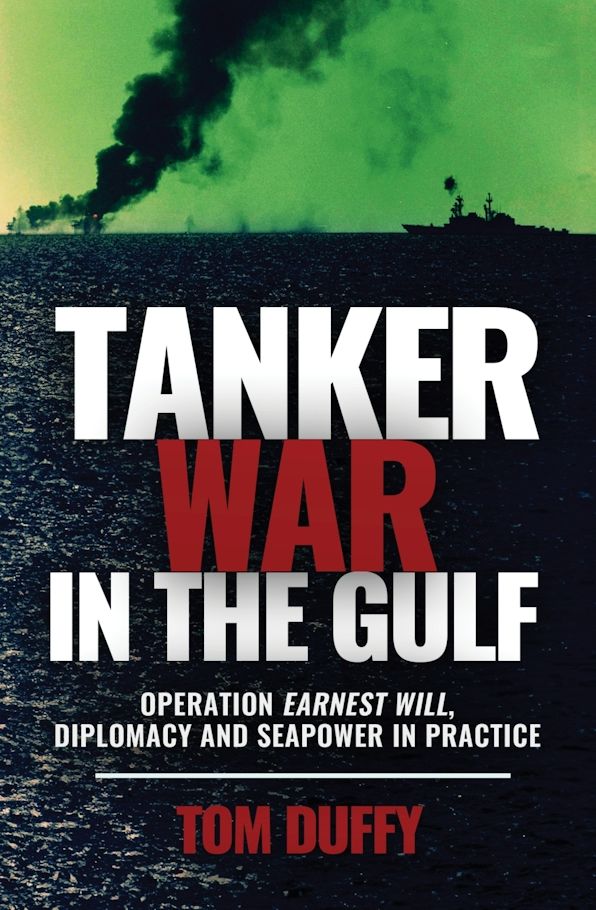
Book Cover for "Tanker War in the Gulf: Operation Earnest Will, Diplomacy and Seapower in Practice"
Author Tom Duffy
Defense, Trade and Foreign Affairs Expert Brings a 38-year Career to Discuss Operation Earnest Will, Diplomacy and Seapower in Practice
Thus is the thesis of the recently published book “Tanker War in the Gulf: Operation Earnest Will, Diplomacy and Seapower in Practice” (Casemate) by Tom Duffy, a retired American diplomat and naval officer with a 38-year year career including service aboard the USS Cochrane during the Tanker War in the late 1980s and as a maritime strategist in the Pentagon with the U.S. Navy’s Strategic Concepts Group.
Although the past four decades have seen a number of U.S. military interventions in the Middle East, only one of can retrospectively be considered a complete success: Operation Earnest Will – the escort of Kuwaiti tankers through the Persian Gulf in 1987 and 1988. As an officer who directly participated in this operation and subsequently served in the same region as a diplomat, Tom Duffy offers a unique perspective on Earnest Will as well as for Epic Fury.
He argues Earnest Will was a success because it was a limited war fought entirely at sea. Almost forty years later, this operation remains relevant not just to current security in the Strait of Hormuz, but also in the longer run with regard to any potential conflicts with China. However, the U.S. is mostly going it alone this time in the Persian Gulf and with a naval fleet that’s about half the size as it was during Earnest Will.
“The Navy doesn't have enough ships to simultaneously perform the convoy missions plus the ‘shoot down incoming missiles’ actions in which we currently have the high-end ships engaged,” Duffy explains. “While we do have 28 quasi-experimental Littoral Combat Ships which are specifically intended to operate close to shorelines, no one seems keen to deploy them in this fight.”
There are also other key differences between the late 1980s and now. The Americans and the Iranians are now unmistakably fighting each other, whereas Earnest Will was more nuanced and indirect. Whereas Earnest Will was a politically limited operation, Epic Fury is a politically unlimited war with articulated American war aims of “regime change” and “unconditional surrender.”
Iran, no longer distracted as before by a border war with Iraq, has been much more successful in controlling the Strait of Hormuz, allowing it to significantly pressure the global economy and seek to divide the U.S. from its usual allies. The Iranian leadership has also been crystal clear on its aims – control the Strait of Hormuz and expel all American military presence from the Persian Gulf – whereas the Trump Administration’s goals have generally been more diffuse and hard to measure. As Duffy sees it, the end to these battles may not be soon: “Iran’s stated conditions for ending the war, which include political guarantees, mean this conflict could drag on for some time.”
In addition, technology has upended the battle, with cheap drones now able to take out critical facilities and evade more expensive and limited interceptor missiles. Still, Duffy argues that while drones may change the character of war, the nature of war remains the same. “The character of war is how the war is fought,” he says. “So to progress from spears to rifles to laser guns would change the character of war, but the nature of war as a human institution – violence, chance, reason – would remain.”
Mr. Duffy, who is available for commentary and interviews based on his research and experience, has recently appeared on podcasts including Sea Control by The Center for International Maritime Security (CIMSEC) and Preble Hall by the U.S. Naval Academy Museum.
About Tom Duffy
Tom Duffy is a retired American diplomat and naval officer. His interests are naval history and maritime strategy. Tom’s assignments over his 38-year overall career with the US Government included service aboard USS Cochrane (DDG-21) during the Tanker War and as a maritime strategist in the Pentagon with the US Navy’s Strategic Concepts Group (OP-603). He retired from the US Navy Reserve as a Commander.
After joining the US Foreign Service, he served primarily in the Middle East, including as the first State Department Foreign Policy Advisor (POLAD) with the US Fifth Fleet in Manama, Bahrain and as US Consul General in Jeddah, Saudi Arabia. Tom spent ten years working on United Nations affairs: four in the Security Council in New York; three running the office overseeing Security Council affairs at the State Department, and three as the US representative to the UN Food Security Agencies in Rome. He also spent two tours teaching national security strategy at the US National War College.
Tom holds a BA in Government from Notre Dame and an MA in War Studies from King’s College, London. He is a graduate of the US Naval War College and was elected an Associate of King’s College London.
For more information about Tom and regular updates on U.S. defense, trade and foreign affairs policies and actions, visit https://www.linkedin.com/in/defensetradeforeignaffairs/
About Casemate Publishers
Founded in 2001, Casemate Publishers is a specialist military history publisher and book distributor, with particular expertise in nonfiction. Our publishing focus is on military history, including unit histories, biography and memoirs, leadership titles, naval warfare, and illustrated histories. Our Casemate Academic imprint publishes academically rigorous titles which span from ancient military strategy to modern conflicts. We offer print and digital books to the public, retailers, museums, wholesalers, and libraries through a variety of channels, platforms, and vendors.
Clients from across the world trust us as their valued distribution partner in reaching new channels and maximizing revenue in the vibrant North American market. Our non-military trade titles are distributed through Casemate IPM. Academic books are available through Casemate Academic.
For more information on Casemate Publishers and its book titles, visit https://www.casematepublishers.com/
Daniel Yesilonis
Casemate Group
+1 610-853-9131
daniel.yesilonis@casematepublishers.com
Visit us on social media:
LinkedIn
Legal Disclaimer:
EIN Presswire provides this news content "as is" without warranty of any kind. We do not accept any responsibility or liability for the accuracy, content, images, videos, licenses, completeness, legality, or reliability of the information contained in this article. If you have any complaints or copyright issues related to this article, kindly contact the author above.
